 Wildlife
of the Philippines
Writhe-billed Hornbill
Hornbills, Hoopoes & Trogons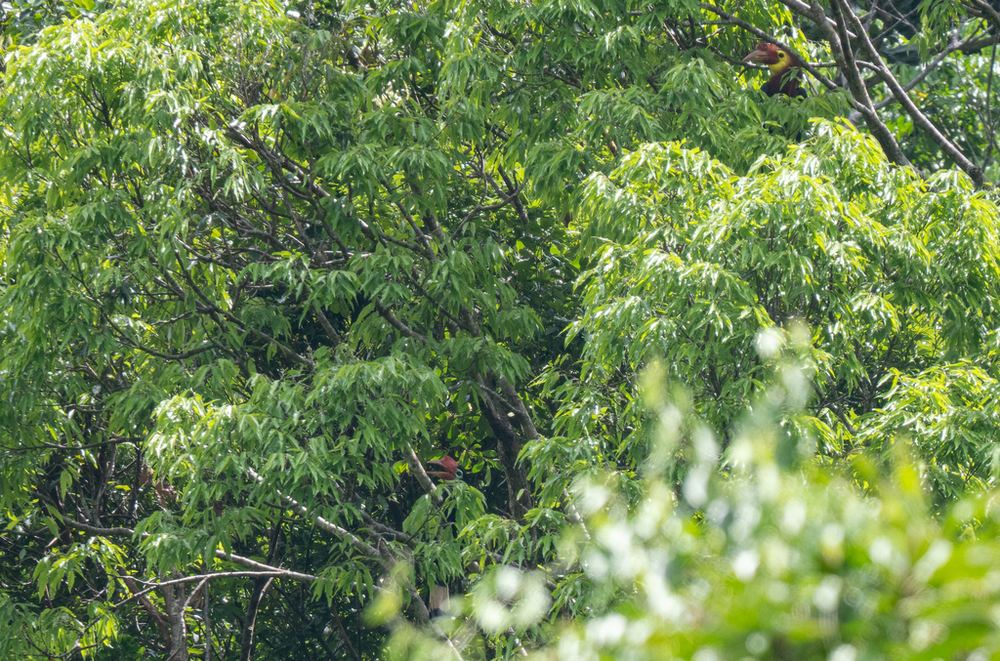
Photo: (c) Forest Botial-Jarvis, some rights reserved (CC BY) · CC BY
Rhabdotorrhinus waldeni
Philippine national list: Critically Endangered (CR)
Basic stats
Diet
Mainly figs and berries; also insects, lizards and other small animals
Habitat
Closed-canopy forest in the lowlands and foothills, also logged areas and isolated trees in clearings
Range
Panay and Negros in the western Visayas; presumed lost from Guimaras
Weight
About 1.1kg (AVONET, Tobias et al. 2022)
Walden's hornbill, also called the writhe-billed or rufous-headed hornbill, is a large mostly black hornbill with a cream tail that has a black band at the tip, an orange casque and a wrinkled lower bill. The male has a rufous head with yellow skin around the eye and a yellow throat pouch; the female has a black head and neck, a smaller bill and casque, and blue and yellow skin around the eye and on the chin. It was once treated as the same species as the writhed hornbill of Mindanao, but voice and plumage differ. The call includes a three-noted throaty chuckle (eBird species account; Wikipedia).
It lives in small noisy flocks, occasionally of 25–30 birds, and may move locally to follow fruit. It nests in natural or carved-out tree cavities and breeds slowly; where nest sites are scarce, nest boxes are being fixed to trunks. Most of the remaining birds live in the unprotected Central Panay Mountain Range, and poaching of nests has been a serious problem there; Negros may hold only a few. On this guide it is a western Visayas specialist, one of the region's 'Big 5' with the Negros bleeding-heart, Visayan spotted deer, Visayan hornbill and Visayan warty pig, and is hard to find (Wikipedia, citing published sources).
Quick answers
- What does the Writhe-billed Hornbill eat?
- Mainly figs and berries; also insects, lizards and other small animals
- What habitat does the Writhe-billed Hornbill live in?
- Closed-canopy forest in the lowlands and foothills, also logged areas and isolated trees in clearings
- Where is the Writhe-billed Hornbill found?
- Panay and Negros in the western Visayas; presumed lost from Guimaras
- How much does the Writhe-billed Hornbill weigh?
- About 1.1kg (AVONET, Tobias et al. 2022)