
 Wildlife
of the Philippines
Philippine Cockatoo
Parrots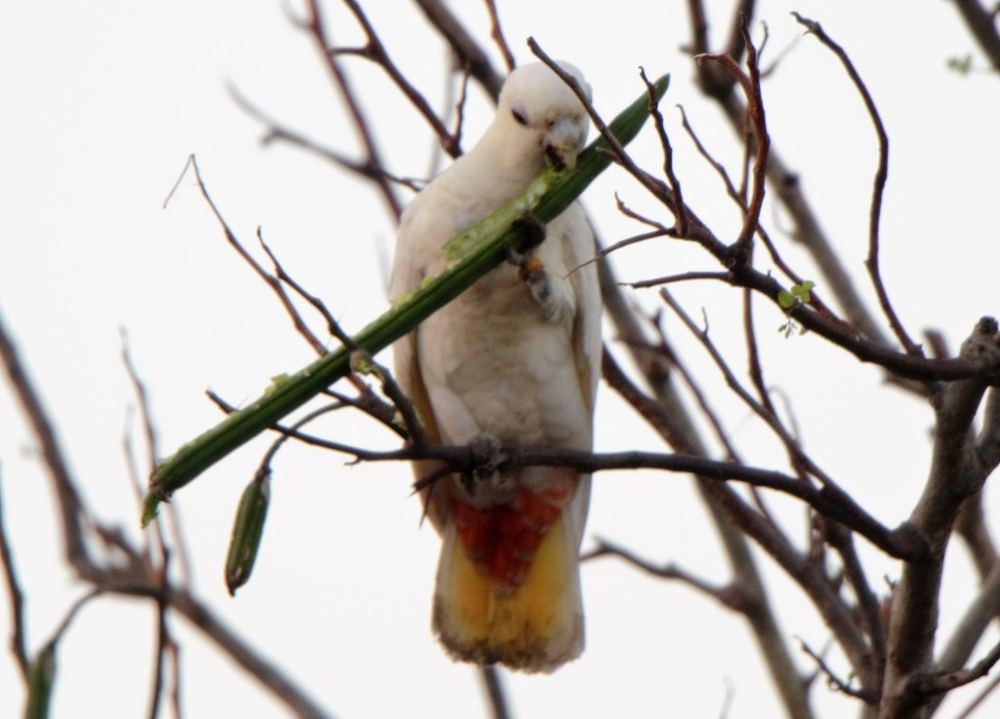
Photo: no rights reserved · CC0
Cacatua haematuropygia
Philippine national list: Critically Endangered (CR)
Basic stats
Diet
Mostly seeds, also fruit, flowers and nectar; raids rice and corn
Habitat
Lowland forest below about 50m, mainly along rivers and coasts with mangrove, and forest edge
Range
Formerly most Philippine islands; now mainly Palawan and the Sulu Archipelago, with remnants on Bohol and Samar
Clutch size
2–3 eggs (captive breeding)
Incubation period
About 28 days
Size
About 30cm
Weight
About 290g (AVONET, Tobias et al. 2022)
The Philippine cockatoo, also called the red-vented cockatoo or katala, is the only wholly white land bird in the islands, so it is hard to confuse (Collins Bird Guide). The red feathers under the tail give it away: the undertail coverts are red with white tips, while the rest of the undertail is yellowish and the underwings are pale yellow. It is smaller than most cockatoos and quieter, with a bleating call alongside the screeches and whistles typical of the family (Wikipedia, general species account).
It feeds mostly on seeds, and also takes fruit, flowers and nectar; it eats rice and corn, which is why farmers have treated it as a pest. Non-breeding birds roam in flocks of up to about 30 (Collins Bird Guide). Nests are in tree cavities, mainly from February to June. Captive breeding shows a clutch of two or three white eggs, about 28 days of incubation and nine to ten weeks before the chicks leave the nest (Wikipedia, general species account).
Once found on nearly every large island and many small ones, it has been lost from most of its range, mainly because chicks were taken from nests for the cage-bird trade. Its stronghold is the Palawan region, where the Katala Foundation has run a conservation programme since 1998; around 180 birds live in the wild around Narra and Puerto Princesa, including Rasa Island. Key sites went from 23 birds in 1998 to 260–340 by the end of 2015, and a nest-protection scheme on Pandanan raised its colony from 40 to at least 230. Droughts on Rasa have caused nest failure of up to 60% (Wikipedia, citing the Katala Foundation and published sources).
Quick answers
- What does the Philippine Cockatoo eat?
- Mostly seeds, also fruit, flowers and nectar; raids rice and corn
- What habitat does the Philippine Cockatoo live in?
- Lowland forest below about 50m, mainly along rivers and coasts with mangrove, and forest edge
- Where is the Philippine Cockatoo found?
- Formerly most Philippine islands; now mainly Palawan and the Sulu Archipelago, with remnants on Bohol and Samar
- How many eggs does the Philippine Cockatoo lay?
- 2–3 eggs (captive breeding)
- How long are the eggs of the Philippine Cockatoo incubated?
- About 28 days
- How big is the Philippine Cockatoo?
- About 30cm
- How much does the Philippine Cockatoo weigh?
- About 290g (AVONET, Tobias et al. 2022)