 Wildlife
of the Philippines
Philippine Colugo
Monkeys, Gibbons, Lorises & Colugo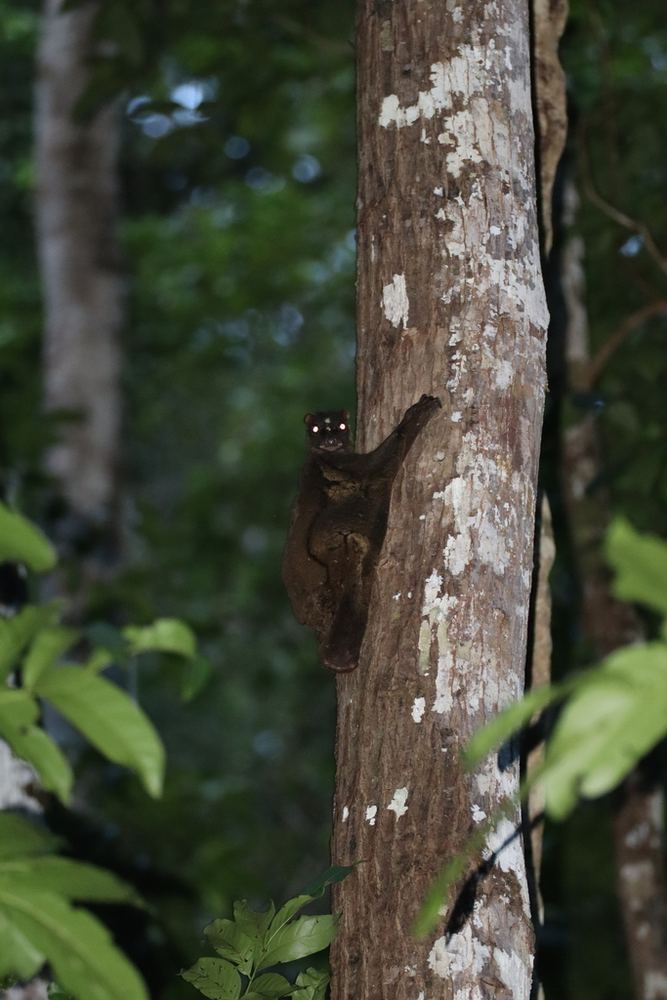
Photo: (c) spacegecko, some rights reserved (CC BY) · CC BY
Cynocephalus volans
Philippine national list: unknown
Basic stats
Diet
Young leaves, occasionally soft fruit, flowers, shoots and insects
Habitat
Lowland and mountain forest, sometimes coconut, banana and rubber plantations; needs trees taller than about 25m for gliding
Range
Southern Philippines: Mindanao, Bohol, Samar, Leyte, Dinagat, Siargao and Basilan
Litter size
1
Gestation period
Estimated at 60–150 days
Size
Head and body 33–42cm; tail 17–28cm
Weight
About 1.0–1.7kg
The Philippine colugo, or flying lemur, is neither a lemur nor a true flier: it glides between trees on a furry membrane that reaches from the neck to the fingers, the hind limbs and the tail, the most extensive gliding membrane of any mammal along with the Sunda colugo's. Glides of 100m or more are recorded. The coat is short and soft, brown to grey, often with white spots, and females are usually greyer than the more rufous males. The head is wide with large forward-facing eyes, and the lower incisors are comb-like (Wikipedia, general species account; Handbook of the Mammals of the World).
Colugos are strictly nocturnal and arboreal, moving clumsily on tree trunks and poorly on the ground. They forage through the night in two peaks, one in the evening and one before dawn, and are mostly solitary, though small groups of a male, two to four females and young are seen. A mother carries her single young across her belly while gliding. On this guide look for the species at night on Bohol, Leyte, Samar and Mindanao; it is a main prey of the Philippine eagle (Wikipedia and Handbook of the Mammals of the World, via GBIF species account).
Quick answers
- What does the Philippine Colugo eat?
- Young leaves, occasionally soft fruit, flowers, shoots and insects
- What habitat does the Philippine Colugo live in?
- Lowland and mountain forest, sometimes coconut, banana and rubber plantations; needs trees taller than about 25m for gliding
- Where is the Philippine Colugo found?
- Southern Philippines: Mindanao, Bohol, Samar, Leyte, Dinagat, Siargao and Basilan
- What is the litter size of the Philippine Colugo?
- 1
- How long is the gestation period of the Philippine Colugo?
- Estimated at 60–150 days
- How big is the Philippine Colugo?
- Head and body 33–42cm; tail 17–28cm
- How much does the Philippine Colugo weigh?
- About 1.0–1.7kg