 Wildlife
of the Philippines
Golden-capped Flying Fox
Fruit Bats & Flying Foxes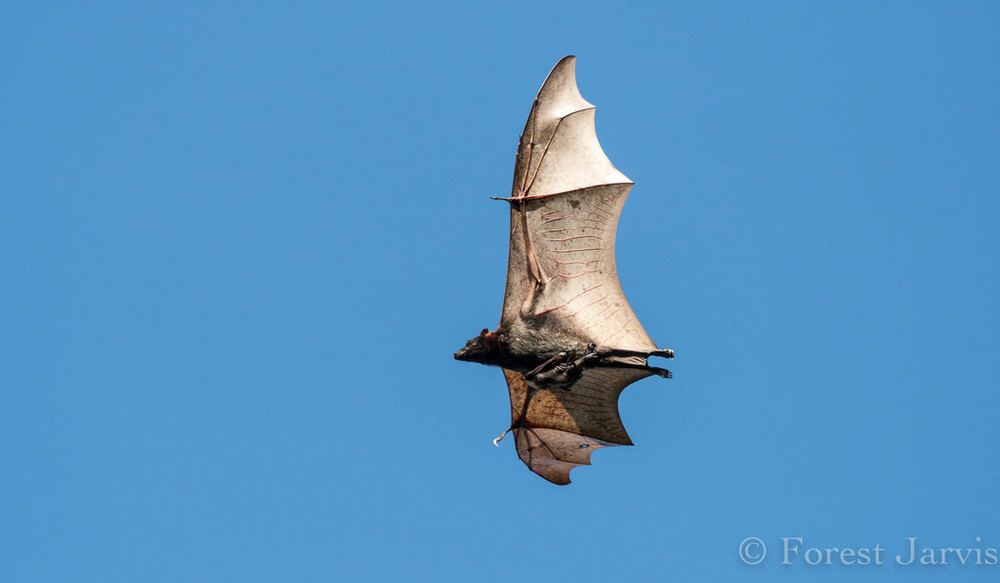
Photo: (c) Forest Botial-Jarvis, some rights reserved (CC BY) · CC BY
Acerodon jubatus
Philippine national list: Critically Endangered (CR)
Basic stats
Diet
Mainly figs and other fruit, some leaves
Habitat
Large primary and good secondary forest at low elevation, often in mangroves, small islands, foothills or steep cliffs, up to about 1,100m
Range
Philippines except the Palawan region: recorded on Bohol, Cebu, Leyte, Luzon, Mindanao, Mindoro, Negros and Polillo
Litter size
1 pup
Size
Forearm 182–205mm; wingspan 1.5–1.7m
Weight
About 0.8–1.4kg
The golden-capped flying fox, also called the giant golden-crowned flying fox, is one of the largest bats in the world. Only the Indian and great flying foxes can weigh more, and its forearm, up to 21cm, is the longest of any bat. A golden-yellow patch of fur runs from between the eyes over the crown to the nape, the mantle is chestnut to brown and the rest of the body is dark brown, often sprinkled with coarse golden or silvery hairs. The muzzle is short, dark and narrow, and the eyes are large with brown irises (Wikipedia, general species account; Handbook of the Mammals of the World).
It feeds at night on figs and some leaves and sleeps in tree roosts by day, sometimes in colonies of thousands that include the large flying fox. Colonies leave the roost shortly before dusk. Females give birth to a single pup once a year, from April to June. The species prefers dense forest and is more sensitive to disturbance than the Pteropus flying foxes sharing its range; it rarely feeds in orchards. On this guide it is a roost-watching species at Subic Bay and in the Northern Sierra Madre, but disturbing roosts by day harms the colony (Wikipedia and Handbook of the Mammals of the World, via GBIF species account).
Quick answers
- What does the Golden-capped Flying Fox eat?
- Mainly figs and other fruit, some leaves
- What habitat does the Golden-capped Flying Fox live in?
- Large primary and good secondary forest at low elevation, often in mangroves, small islands, foothills or steep cliffs, up to about 1,100m
- Where is the Golden-capped Flying Fox found?
- Philippines except the Palawan region: recorded on Bohol, Cebu, Leyte, Luzon, Mindanao, Mindoro, Negros and Polillo
- What is the litter size of the Golden-capped Flying Fox?
- 1 pup
- How big is the Golden-capped Flying Fox?
- Forearm 182–205mm; wingspan 1.5–1.7m
- How much does the Golden-capped Flying Fox weigh?
- About 0.8–1.4kg